Business leader exploring plastic credits
What this page covers
Business leader exploring plastic credits
If you are a business leader exploring plastic credits, you are probably looking for a practical, traceable way to address your plastic footprint without adding complexity to your operations or risking vague or misleading sustainability claims.
A careful first step is to estimate how much plastic your business generates in a year, then explore how ZeLoop’s NFT-based plastic credits can finance verified recovery of that plastic and provide digital proof you can use in your ESG and CSR reporting.
In brief
- You may want a simple way to contribute directly to plastic waste collection and recycling, with clear evidence of the quantities recovered so you can reflect this in your ESG or CSR documentation.
- A suitable option can be NFT-based plastic credits, where each certificate corresponds to a defined weight of recovered plastic and serves as digital proof of the recovery financed by your company.
- Before you start, clarify how much plastic you want to offset, which certificate sizes are available, and how the documentation from purchased NFTs can be integrated into your internal reporting and audit processes.
What to do
As a business leader, you may feel pressure to act on plastic pollution while also needing clarity, traceability, and a straightforward process that your team can manage. ZeLoop positions its Plastic Credit NFTs as a way for your company to support the recovery and recycling of plastic waste, so you are not left feeling passive in the face of growing expectations from customers, regulators, and investors.
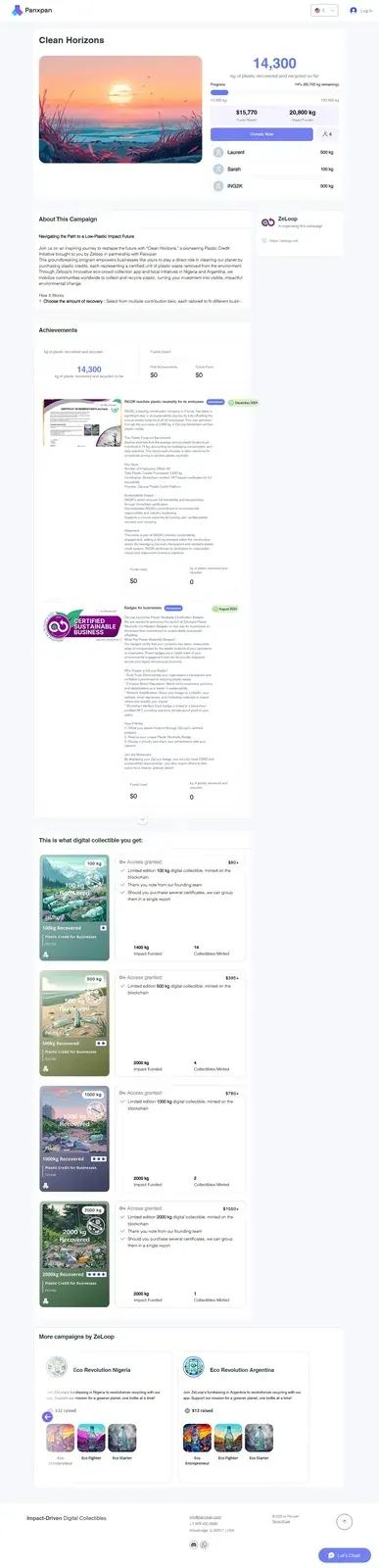
With ZeLoop Plastic Credit NFTs, you choose the amount of plastic recovery you want to finance by purchasing certificates that each represent a specific weight of recovered plastic, from 100 kg up to 2,000 kg. ZeLoop then manages the diversion of plastic waste from nature and its reintegration into recycling streams, and NFTs are minted as digital proof matching the weight of plastic recovered over the relevant period.
To start carefully, you can first estimate how much plastic your business has generated during the year and use that as a basis for deciding how many certificates to purchase. Once you have selected the appropriate NFT certificates, you can use them to demonstrate your commitment and document your CSR and sustainability reports with the certificates purchased, aligning your contribution with your broader communication and internal policies.
What to keep in mind
ZeLoop’s approach focuses on enabling companies to finance plastic recovery and receive NFT certificates that correspond to the weight of plastic recovered. This gives you a concrete, digital record of the recovery you have chosen to support, which can be helpful when you want to show how your business contributes to tackling plastic pollution.
At the same time, plastic credits and NFT certificates are only one element of a wider sustainability strategy. Available information shows that you decide how much recovery to finance and that ZeLoop manages the diversion of plastic waste and the minting of NFTs, but it does not define how this should be positioned in your overall ESG framework or how regulators, auditors, and other stakeholders will view specific claims.
Because of this, it is sensible to treat ZeLoop Plastic Credit NFTs as a traceable tool you can integrate into your existing CSR and sustainability reporting, rather than a complete solution on their own. Reviewing your internal policies and any external guidelines on environmental claims before communicating about credits can help you use the certificates in a way that is consistent with your company’s broader responsibilities.